
Haywood County Court Docket Basics
A docket is the chronological court record of events in a case. In Haywood County court dockets, a reader may see filing dates, hearings, continuances, orders, dispositions, financial entries, and other case events. Portal training uses the phrase Case Summary or Register of Actions for the timeline view. That timeline is useful for tracking a case, but it does not always provide every filed document, exhibit, order, or paper record held by the Clerk of Superior Court.
Because North Carolina uses a unified General Court of Justice, Haywood County court dockets are not split among separate municipal courts for public record access. Waynesville, Canton, Clyde, and Maggie Valley police may issue citations or make arrests, but the court docket belongs to the statewide trial court system. Superior Court covers felony cases, higher civil matters, and many appeals. District Court covers misdemeanors, infractions, traffic, juvenile, domestic, small claims, landlord-tenant, and lower civil matters. Magistrates handle initial criminal processes and small claims work under District Court.
The official statewide entry point is the NC eCourts Portal.
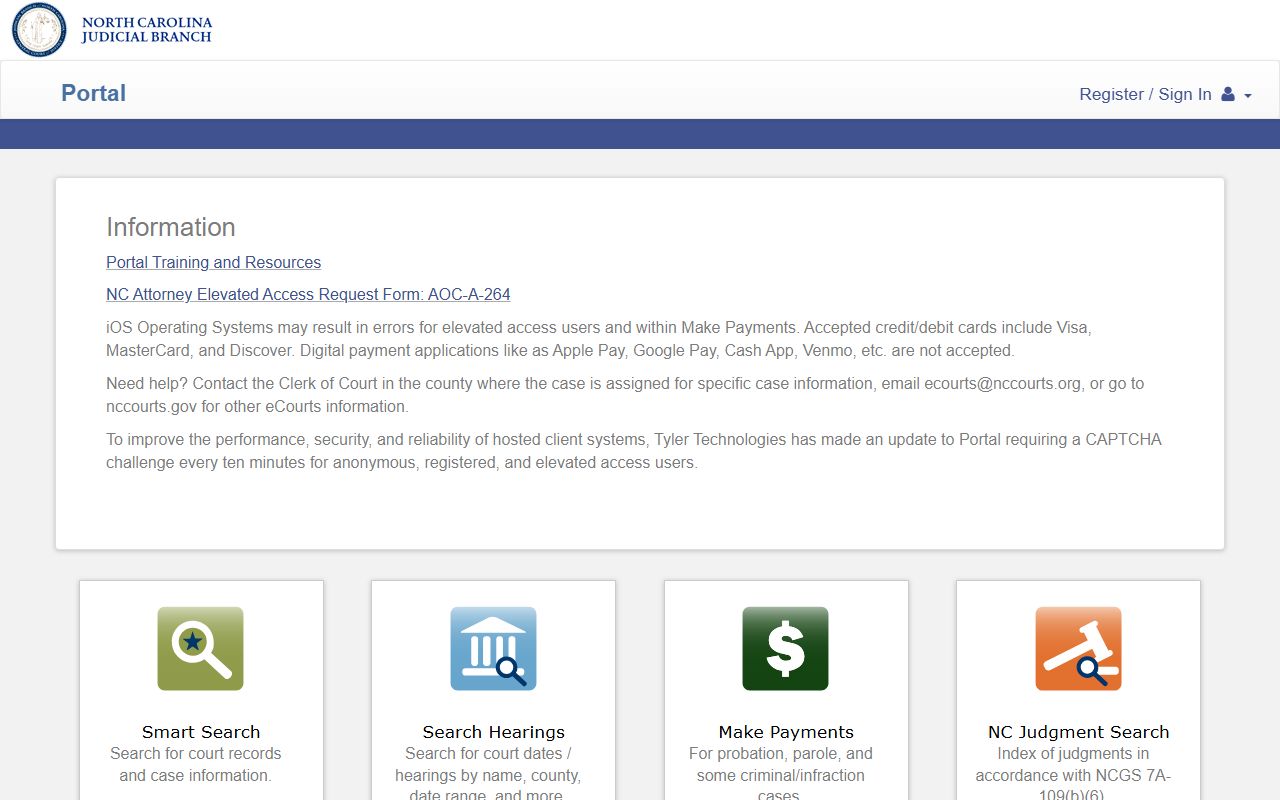
Portal is the right place to start when the goal is a public docket timeline or hearing lookup.
Find Haywood County Court Dockets Online
Haywood County court dockets can be searched in Portal by case number, party name, citation number, business name, attorney name, attorney bar number, judicial officer, courtroom, county, and other filters shown by the system. The Haywood County NC Courts page also links to civil calendars, criminal calendars, court-date search, local administrative schedules, and local rules. Use the calendar tools when the need is a date, time, courtroom, or judge. Use Smart Search when the need is the case event history.
- Start from the Haywood County NC Courts page or open Portal directly.
- Choose Smart Search for a case docket timeline, or Search Hearings / Find a court date for calendar details.
- Enter the case number, party name, business name, citation number, attorney name, or attorney bar number.
- Select Haywood County in the county or location filter before adding date, courtroom, judicial officer, or case type filters.
- Open the result and compare the event list, hearing list, disposition, and financial entries with any local calendar listing.
The NC Courts Portal training page describes Smart Search, Search Hearings, online payments, and advanced filters.
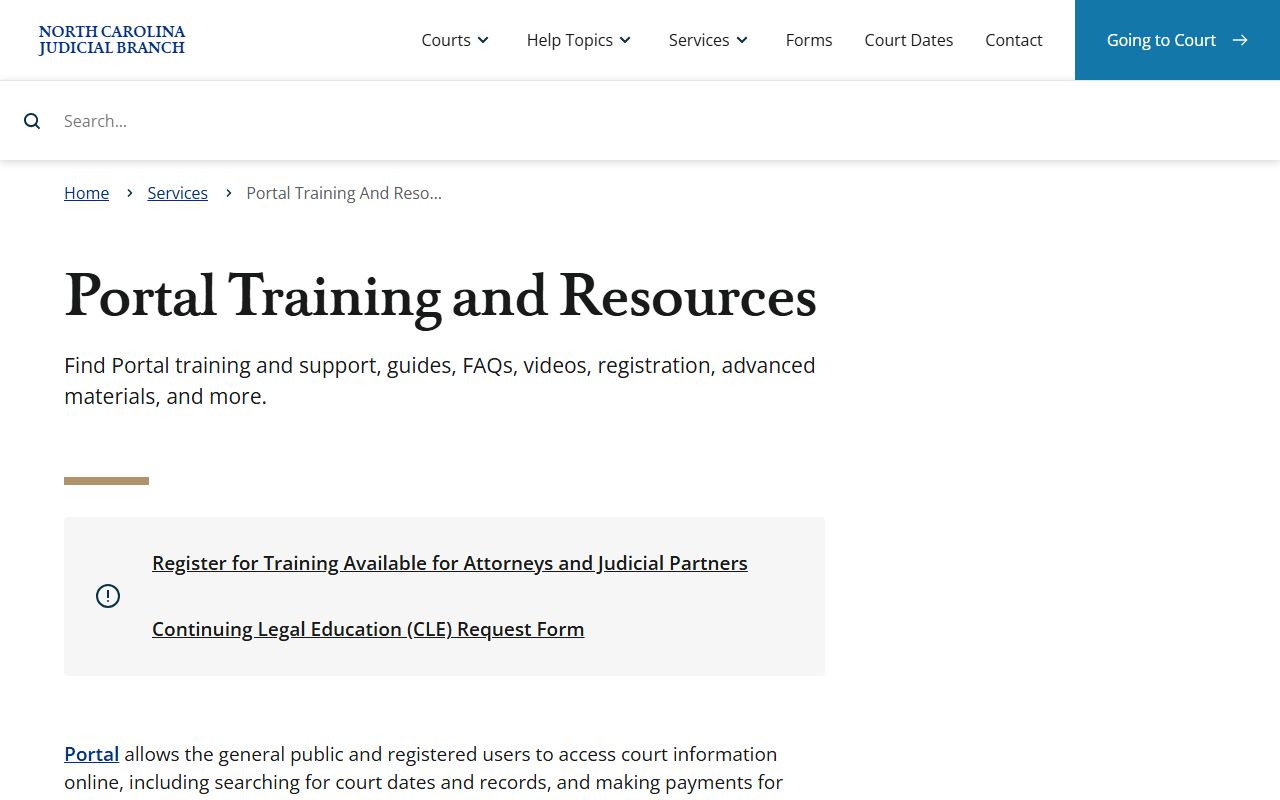
Training material is useful when Portal labels differ from the terms used in a local notice or calendar.
Haywood County Docket Search Fields
The hearing search fields are aimed at time and place. They help locate a future or recent calendar entry even when the user does not need the whole case file. For Haywood County court dockets, the county filter matters because statewide name searches can return cases from many counties.
| Field | What It Shows or Does |
|---|---|
| Case Number | Finds a specific case or hearing when the record number is known. |
| Party Name | Searches hearings by a person's name in the case. |
| Business Name | Searches dockets for business-party cases. |
| Attorney Name / Bar Number | Narrows hearings tied to counsel of record. |
| Judicial Officer | Limits results by judge or other listed judicial officer when available. |
| Courtroom | Filters by courtroom or calendar location when displayed. |
| County | Select Haywood County to localize the search. |
| Citation Number | Finds traffic or infraction dates tied to a citation. |
Sample docket entries may include the event date, event type, hearing date and time, courtroom, judicial officer, party or attorney, disposition, financial entry, and document availability. If the docket line points to a restricted proceeding, the public view may show little or no detail.
Haywood County Court Calendar Sources
The Haywood County local administrative schedules page is a key local docket source. It links to administrative schedules, civil calendars, criminal calendars, and court-date search. These calendar tools are practical for checking when a matter is set, while Portal's case summary is better for seeing the docket events that led to that date.
Local rules also affect docket timing. The Haywood local rules page lists a Criminal Case Docketing Plan for the 43rd Prosecutorial District, Rules for Civil Superior Court in Judicial District 30B, a Superior Court Continuance Policy, District Court Local Rules of Criminal Procedure, Local Rules for Court-Ordered Arbitration, and a domestic mediation addendum for the 43rd Judicial District. Those documents explain why continuances, mediation, and docket calls may differ by division even though case access uses the same court system.
The local administrative schedules source appears here: Haywood County local administrative schedules.
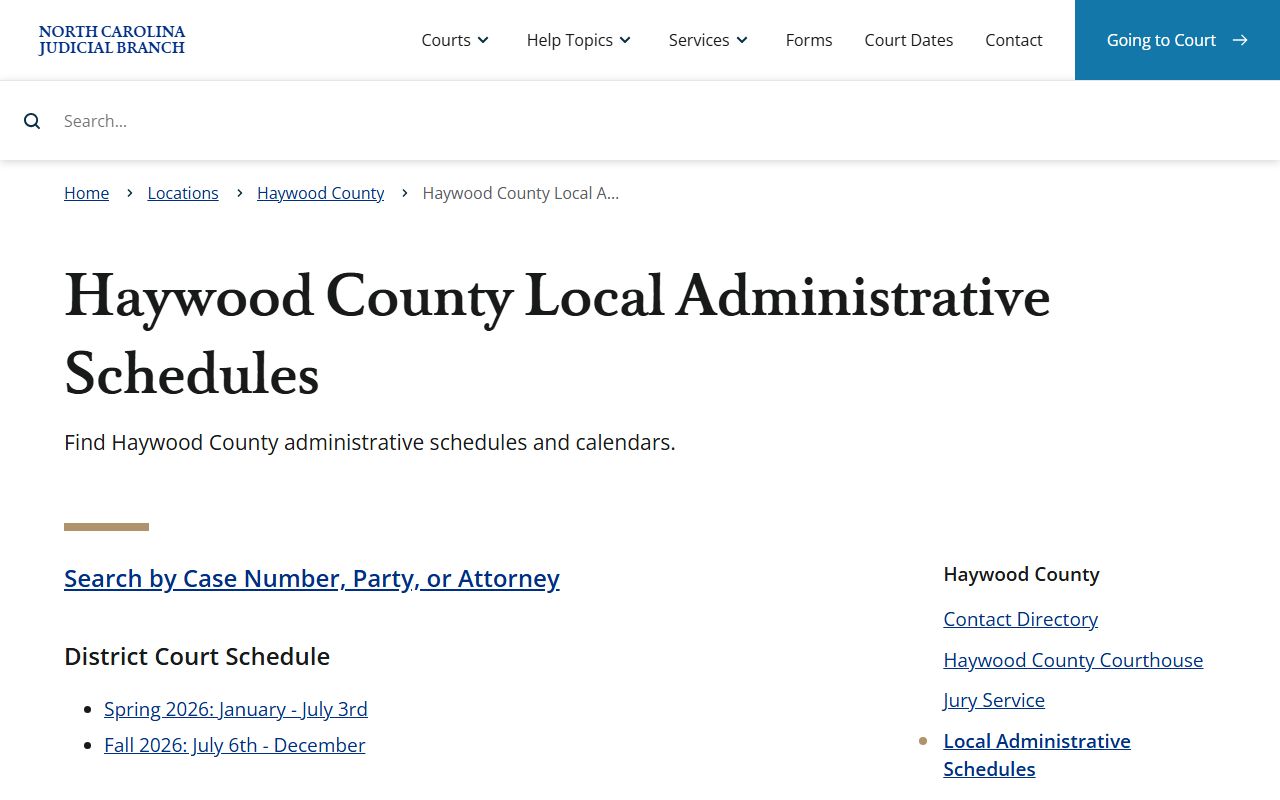
Use schedules for court date planning, then use the case docket to confirm the event history and any later disposition.
Courts With Haywood County Dockets
Haywood County dockets are tied to state court divisions rather than a county-run court. The Clerk of Superior Court keeps the case file for both Superior Court and District Court. The NC Courts contact directory lists local phone lines for the District Attorney, Superior Court Judges, District Court Judges, Clerk of Superior Court, civil magistrates, criminal magistrates, arbitration, custody and visitation mediation, and Guardian ad Litem.
- Superior Court dockets cover felony cases, higher civil disputes, and many appeals from District Court.
- District Court dockets cover misdemeanors, infractions, traffic, domestic matters, juvenile cases, small claims appeals, and lower civil cases.
- Magistrate matters can appear through small claims and initial criminal process paths.
- Probate and special proceeding dockets are tied to the Clerk of Superior Court's judicial role.
- Federal dockets use federal systems and are not kept by the Haywood County clerk.
Free legal research tools such as CourtListener can help locate opinions and selected docket data, but they are not the official Haywood County court docket custodian.
When a deadline or hearing is at stake, confirm the docket with NC Courts or the Clerk of Superior Court.
Haywood Dockets vs Case Records
A docket is a map of case activity. The full case record can include the pleadings, motions, orders, judgments, notices, warrants, citations, inventories, letters, accountings, and other public documents behind those entries. Some entries are public, some are redacted, and some are not visible online. For full documents, certified copies, or older paper files, use the Clerk of Superior Court. For broad public case lookup, start with Portal.
| Docket | Full Case Record | |
|---|---|---|
| Format | Chronological list of case events. | Case summary plus filed documents when public and available. |
| Best use | Track hearings, continuances, dispositions, and payments. | Review pleadings, orders, judgments, and certified copies. |
| Access point | Portal, court-date search, civil calendars, criminal calendars. | Portal when available, clerk counter, paper file, or copy request. |
| Limits | May omit details from restricted matters. | May require clerk review, copy fees, or legal authorization. |
For broader case-search steps, the full Haywood County court records path covers Portal, clerk terminals, paper files, and certified searches.
Restricted Haywood County Dockets
Some dockets are limited by case type or by law. Juvenile court records are confidential, even where a hearing may be open in a limited way. Mental health proceedings, adoption records, protected addresses, medical data, financial account numbers, Social Security numbers, and minor details may be hidden or redacted. Chapter 7B Article 30 protects juvenile-record confidentiality, and G.S. 132-1 sets the broad public-record rule only when no other law restricts access.
Law-enforcement records and court records are not the same access channel. If the docket event concerns an arrest, charge, or warrant, the court file may show public case events while Sheriff's investigation records can remain restricted under criminal investigation rules. The Haywood County Sheriff's Office, led by Sheriff Bill Wilke, is the law-enforcement contact for sheriff records, not the docket custodian. The court may have the public case entry, while the agency file sits with the law-enforcement custodian.
Note: A missing public docket detail does not always mean the case was removed; it may be restricted by case type.